// computational researcher · physics × quantitative finance

Rebecca L.
Preston

I build mathematical models of complex, uncertain systems — and validate them against noisy, real-world data.

A NASA Fellow and PhD candidate probing the equation of state of neutron stars, applying the same statistical toolkit to quantitative finance.

PhD Candidate · SMU NASA Fellow Adjunct Professor

Jump to Astrophysics Quantitative finance

Rebecca L. Preston
01

About

I'm a NASA Fellow and PhD candidate in Astrophysics at Southern Methodist University, advised by Dr. Fred Olness and still collaborating with Dr. William Newton at East Texas A&M. I bring 5+ years of Bayesian/MCMC modeling, Monte Carlo simulation, and Python data pipelines built on large, noisy, multi-source datasets.

My research infers neutron star structure from multi-messenger data — fusing heterogeneous streams, stress-testing models under uncertainty, and turning complex statistical output into insight. I've published in Physical Review Letters and Physics Letters B, trained at MIT's National Nuclear Physics Summer School, and built an equation-of-state pipeline now part of the NSF-funded MUSES project.

The same toolkit drives my quantitative-finance work with Traders@SMU's Quantitative Strategies group — market microstructure, backtesting, and risk-aware strategy. And as an adjunct professor at SMU, I teach honors physics built around creative, real-world themes.

Technical skills

Languages & computing
PythonFortranScientific computingVersion control
Statistics & modeling
Bayesian / MCMCMonte CarloUncertainty quantificationNumerical modeling
Quant & ML
Machine learningRKHS / kernelsBacktestingVolatility & risk
Physics domain
Neutron-star EOSDense matterMulti-messenger
02

Research

Two parallel tracks, one methodology: build a principled model, validate it without mercy, and let the data overturn it. Switch between them below.

I'm drawn to just about everything more than 200 miles above sea level — my cheeky shorthand for “legally, space.” In practice, that's dense-matter nuclear astrophysics: connecting laboratory nuclear physics to the interiors of neutron stars. I'm fascinated by combining scales — and problems — that rarely meet: quantum objects on classical scales, which takes a problem-solving intuition that spans all of physics. My focus has evolved a good deal — from undergraduate neutron-skin work to the machine-learning and cooling projects I'm on now.

Concurrent projects sit side by side — select any node to expand it.

Undergraduate · TAMUC · 2019–21
MS, Physics · ETAMU · 2021–23
PhD, Astrophysics · SMU · 2023–present

Systematic quantitative research: kernel methods, regime-aware features, and honest out-of-sample validation for options and cross-asset markets. The physics carries over directly:

  • Bayesian / MCMC inferenceprobabilistic risk modeling & parameter estimation
  • Monte Carlo stress testsscenario analysis & distributional risk summaries
  • ETL pipelines + version controlaudit-ready, reproducible data governance
  • Cross-functional research commstranslating quant outputs for decision-makers
2025–present

Project Nyx

End-of-day options trading pipeline — signal ingestion, feature engineering, trade selection, and IBKR execution — with a 10k-simulation block-bootstrap backtester, regime-aware features, and disciplined position sizing.

2026–present

Relativistic RKHS

A Lorentz-invariant kernel for RKHS models, capturing scale-dependent nonlinear interactions in financial time series — physics intuition, transplanted.

2026–present

Argus — multi-strategy meta-allocation

A seven-model systematic framework (trend, mean-reversion, dealer-flow, cross-asset carry, long-vol, equity factors, inflation-regime) under TSMOM-grade validation: walk-forward, stationary block bootstrap, look-ahead audits, and pre-registered acceptance bars. Three models paper-deployed on IBKR with a Bayesian meta-allocation layer for volatility and correlation budgeting.

Traders@SMU · Leadership & Teaching

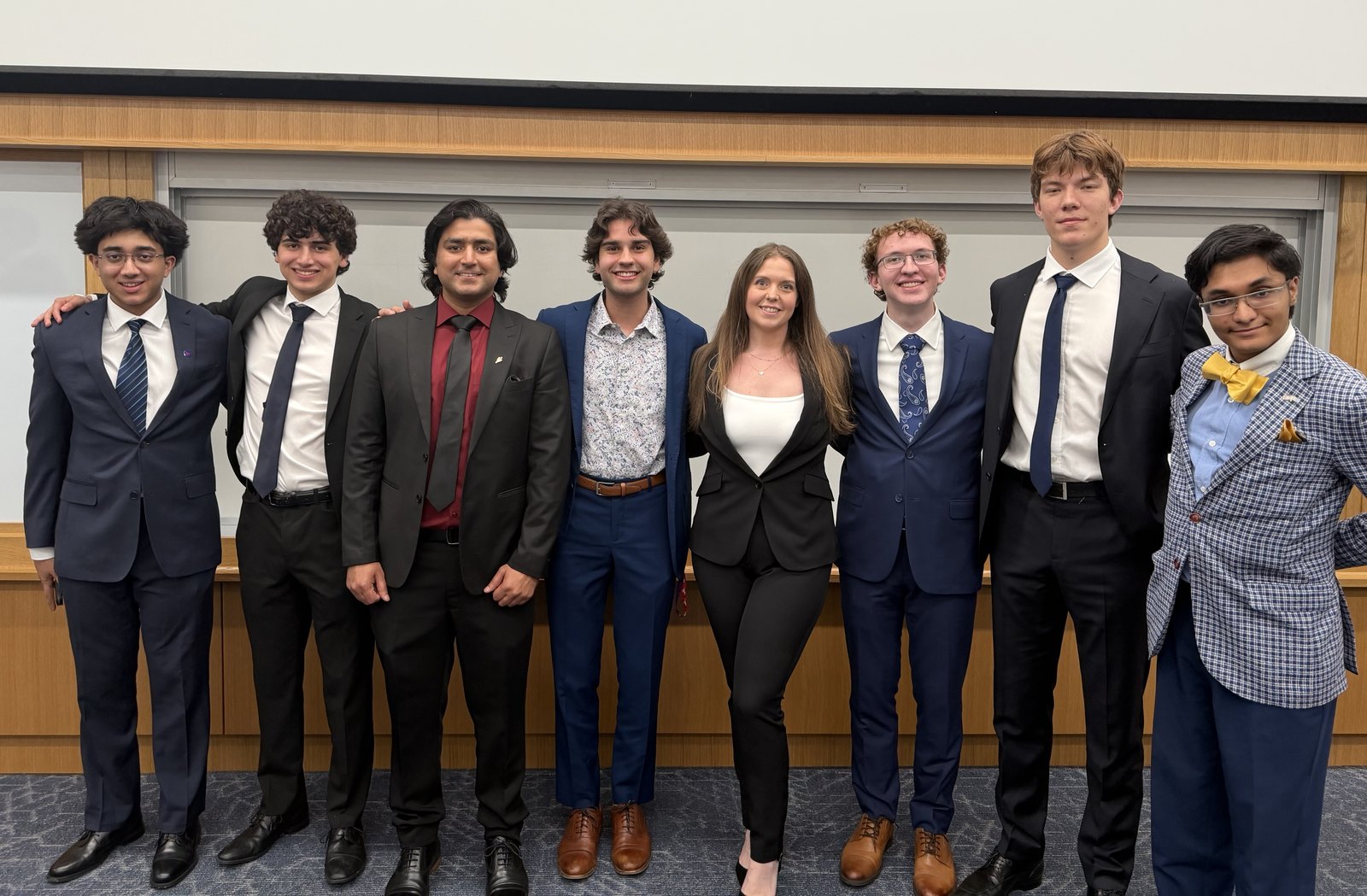
Rebecca Preston with the Traders@SMU Quantitative Strategies team
The Traders@SMU Quantitative Strategies team.

Traders@SMU — Quantitative Strategies

Traders@SMU is SMU's premier trading and markets club — structured like a small multi-strategy hedge fund. In its Quantitative Strategies sector I build systematic, model-driven research in Python; I joined as an analyst, promoted to Co-Sector Head within a single semester, and built the team's full backtesting infrastructure.

I help teach members quantitative strategy and book development hands-on: small, shippable projects on real data that build toward research-grade models. This year's work runs on two tracks.

Track 1

Multi-kernel RKHS — non-linear reversion

A custom Reproducing Kernel Hilbert Space (RKHS) model that finds the non-linear, regime-dependent structure linear factor models (CAPM, Fama–French) miss: the same instrument can trend in one volatility regime and mean-revert in another. On crude-oil futures, it blends fast microstructure signals — order-book shape, order-flow toxicity, price impact, options hedging flows — with slower ones from the volatility risk premium, cross-asset momentum, and news sentiment, staying tractable across tens of millions of trades.

What finally worked came from several method changes I pushed: two-stage estimation, a Kalman filter that treats the kernels as regime detectors rather than return predictors, and inverse-volatility position sizing. Everything runs through out-of-sample validation — purged walk-forward, block-bootstrap Monte Carlo, and historical stress scenarios — to guard against overfitting and look-ahead.

This semester

  • Extend from a single instrument (crude-oil futures) to a full cross-asset universe — equities, futures, currencies, bonds, commodities, and options.
  • Model how shocks propagate through that universe — a “wave generator” driven by rate changes and the reshuffling that follows.
  • Have analysts identify the tickers that best represent each sector and subsector (regressions against sector ETFs).
  • Central question: the best way to measure these high-dimensional factor interactions.
Track 2

Emerging-Markets Derivatives Pricing

The on-ramp. The RKHS model is a high barrier to entry, so new analysts start here — learning options pricing, volatility, and microstructure through small, shippable projects pointed at a real question: how and why emerging markets misprice risk relative to the US, where inefficient or crowded retail flow can stretch prices in ways you don't see at home. It's also a feeder — vol-surface, factor, and microstructure work maps directly onto the RKHS model's Kslow and KGEX thinking, so strong analysts graduate into Track 1.

Goals

  • Build ground-up intuition for options pricing and the volatility surface.
  • Every analyst shipping small projects with real data within the first month.
  • Benchmark US vol structure against one or two EM markets — India first, then Brazil or Korea.
  • Document structural inefficiencies by mechanism, not just the number.

Actively exploring quantitative research, data analytics, and risk-modeling roles in finance — particularly private equity, hedge funds, and investment banking.

03

Teaching

As an adjunct professor at SMU, I teach introductory honors physics — building real physical intuition, and a bridge from the classroom into research.

SMU · 2025–present

Introductory Honors Physics — Adjunct Professor

I use creative, real-world themes to build genuine physical intuition — not just problem-solving reflexes. In one lab, each group got the raw materials for a working headphone — paper cups, magnets, and wire — and no instructions; the first team to build one and name the song on my laptop won Starbucks gift cards. Over two semesters I've doubled the course's enrollment — a real win for the department.

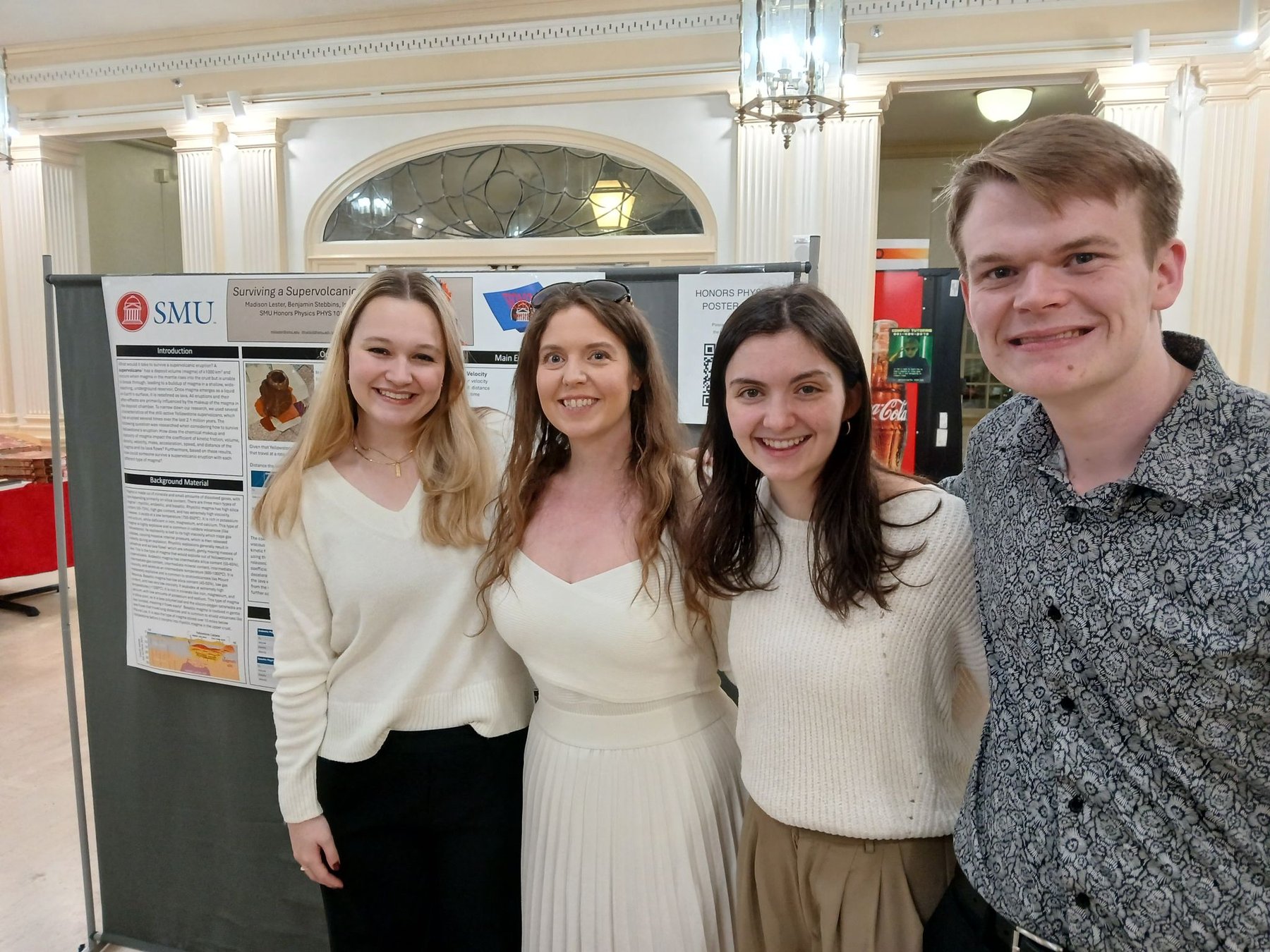
Each semester, students also build toward a real research poster on the course's theme and present it to the department and the school's deans — a genuine research capstone inside an intro class.

To deepen that pull, I bring graduate students and faculty in to present their research, showing students what physics looks like beyond the textbook — and drawing more of them toward both research and further coursework. And I remind them: you don't have to be a physics major to do physics research — it's a way to build skills and strengthen a CV.

Rebecca Preston with honors physics students at their end-of-term poster session at SMU
Students present their end-of-term research posters to the department and the deans.
A student testing a headphone they built from a cup, magnet, and wire during a physics lab
A student tests the headphone they built — a cup, a magnet, and wire — against the song on my laptop.
TAMUC · 2021

Substitute Instructor — PHYS 420, Quantum Mechanics

In my first semester of grad school, the undergraduate quantum-mechanics professor fell ill and the department asked me to take over the course — my first time leading a university classroom.

04

Publications

  1. 2022

    Constraining Nuclear Symmetry Energy with Multi-messenger Resonant Shattering Flares

    D. Neill, R. Preston, W. G. Newton, D. Tsang

    Physical Review Letters 130, 112701

    Abstract

    Much effort is devoted to measuring the nuclear symmetry energy through neutron star (NS) and nuclear observables. Since matter in the NS core may be non-hadronic, observables like radii and tidal deformability may not provide reliable constraints on properties of nucleonic matter. We demonstrate that coincident timing of a resonant shattering flare (RSF) and gravitational wave signal during binary NS inspiral probes the crust–core transition region and provides constraints on the symmetry energy comparable to terrestrial nuclear experiments. We show that nuclear masses, RSFs and measurements of NS radii and tidal deformabilities constrain different density ranges of the EOS, providing complementary probes.

  2. 2021

    From neutron skins and neutron matter to the neutron star crust

    W. G. Newton, R. Preston, L. Balliet, M. Ross

    Physics Letters B 834, 137481

    Abstract

    We present the first Bayesian inference of neutron star crust properties to incorporate neutron skin data, including the recent PREX measurement of the neutron skin of 208Pb, combined with recent chiral effective field theory predictions of pure neutron matter with statistical errors. Using a compressible liquid drop model with an extended Skyrme energy-density functional, we obtain the most stringent constraints to date on the transition pressure Pcc = 0.33 ± 0.07 MeV fm−3 and chemical potential μcc = 12.6 (+1.8/−1.9) MeV (which control the mass, moment of inertia and thickness of a neutron star crust), the proton fractions that bracket the pasta phases yp = 0.115 (+0.016/−0.017) and ycc = 0.041 (+0.007/−0.006), as well as the relative mass and moment of inertia ΔMp/ΔMc ≈ ΔIp/ΔIc = 0.54 (+0.05/−0.09) and thickness ΔRp/ΔRc = 0.129 (+0.019/−0.030) of the layers of non-spherical nuclei (nuclear pasta) in the crust.

In Preparation

05

Education

2023 – present

PhD, Astrophysics

Southern Methodist University

Advisor: Dr. Fred Olness

Nuclear astrophysics: inferring neutron-star structure and cooling from dense-matter physics, and building machine-learning methods for nuclear cross-sections with the SURGE collaboration.

2021 – 2023

MS, Physics

Texas A&M University–Commerce (now East Texas A&M)

Advisor: Dr. William G. Newton · Thesis: Inference of whole neutron star EOS from combined astrophysical and nuclear observables

Nuclear theory and astrophysics: constraining the equation of state and nuclear symmetry energy by combining neutron-star observations with laboratory nuclear data under Bayesian inference.

2019 – 2021

BS, Physics Astrophysics concentration

Texas A&M University–Commerce · Magna Cum Laude

Advisor: Dr. Kent Montgomery

Early research on the nuclear symmetry energy and neutron-star crust — where the dense-matter work I still do began.

2009 – 2017

AA, Art

Collin College

A foundation in visual art and design — the creative roots of how I teach and communicate science.

06

Honors & Fellowships

Rebecca Preston at the Facility for Rare Isotope Beams (FRIB), Michigan State University
At the Facility for Rare Isotope Beams (FRIB), Michigan State University.

Awards & Fellowships

  • 2022–26 NASA / Texas Space Grant Fellowship (2022–23, 2023–24, 2025–26)
  • 2022 1st Place — TAMUC Annual Research Symposium, Oral Presentation
  • 2022 Outstanding Graduate Student — TAMUC Physics & Astronomy
  • 2021 Outstanding Undergraduate Researcher — TAMUC Physics & Astronomy
  • 2020 1st Place — Texas Section APS, Outstanding Undergraduate Presentation
  • 2019–21 NSF Physics & Astronomy Scholarship for Success

Academic Honors

  • 2021 Sigma Pi Sigma — honorary national physics society
  • 2021 Magna Cum Laude
  • 2020 President's List
  • 2019, 21 Dean's List

Summer Schools

  • CTEQ School on QCD & Electroweak Phenomenology MSU · 2025

    Quantum chromodynamics, parton distributions, and electroweak collider phenomenology.

  • HEFTY High-Energy Frontier Theory School Santa Fe · 2024

    High-energy frontier theory — effective field theory and beyond-the-Standard-Model physics.

  • National Nuclear Physics Summer School MIT · 2022

    A selective U.S. school in nuclear theory and experiment — nuclear structure, QCD, and nuclear astrophysics.

  • École Joliot-Curie Oléron, France · 2022

    France's international school on nuclear physics and astrophysics, named for Frédéric & Irène Joliot-Curie.

07

Get in touch

Open to collaboration in nuclear and dense-matter astrophysics, and to teaching and research conversations. I'm also actively seeking finance internships and full-time roles — quant research and data science are my strengths, but I'm genuinely open across finance. Email's the best way to reach me.